
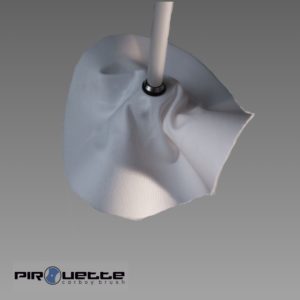
If you’ve ever tried to scrub dried yeast or tartrate crystals off the bottom of a 5-gallon carboy with a standard bottle brush, you already know the problem: it’s too short, too stiff, and it can’t reach the curve of the glass without scratching it. This guide compares every realistic option — from basic bottle brushes to drill-powered rotating cleaners — so you can pick the right carboy cleaning brush or demijohn brush for the size of vessel you actually own, without wasting money on the wrong tool.
Quick answer: for anything larger than a standard wine bottle — a carboy, demijohn, or glass fermenter — a drill-powered rotating brush with a soft cotton disc is the fastest and safest option. A manual bottle brush works fine for narrow-neck bottles but struggles once you’re past about 5 litres. Details, trade-offs, and sizing below.
Table of contents
- Why a regular bottle brush isn’t enough for a carboy or demijohn
- What to look for in a carboy cleaning brush
- Bottle & carboy cleaning brushes compared
- How a drill-powered rotating brush actually works
- Which size do you need?
- FAQ

Why a regular bottle brush isn’t enough for a carboy or demijohn
Standard bottle cleaning brushes are built for narrow-neck wine or beer bottles — they’re short, thin, and rely on stiff bristles to physically dislodge residue. Once you move up to a carboy or demijohn (typically 10–54 litres), three problems show up at once:
- Reach. Most bottle brushes are 30–40 cm long. A large carboy is roughly 50–60 cm tall, so the brush simply can’t get to the bottom or scrub the widest part of the belly.
- Material. Wire-core or hard nylon bristles that are fine on a narrow bottle can leave fine scratches on the inside of a wide glass vessel — and scratched glass is harder to sanitize and more prone to stress cracks over time.
- Effort. Hand-scrubbing a carboy with a brush or a sponge-on-a-stick against dried-on tartrate crystals or yeast cake can take 15–20 minutes of shaking and scrubbing, and stubborn spots often don’t come off at all.
That’s the gap that drill-powered rotating brushes were built to close.
What to look for in a carboy cleaning brush
Rod length & diameter
The rod needs to comfortably reach the full height of your vessel with room to manoeuvre — for a 40–54 litre carboy that generally means at least 75–80 cm. Rod diameter matters too: it has to fit the chuck of a standard cordless drill (most residential drills accept anywhere from 0–10 mm).
Disc/head material
This is the single biggest factor in whether the brush scratches your glass. Wire bristles and hard plastic are the most common cause of visible scratching. A disc made from natural cotton or a cotton-and-wool blend flexes against the glass instead of scraping it, while still being abrasive enough to lift dried residue.
Manual vs. drill-powered
A manual brush relies entirely on your arm. A drill-powered brush uses centrifugal force from the spinning disc to do the scrubbing for you — this is the difference between a job that takes 15–20 minutes of shaking and one that takes under 2 minutes.
Food-safe certification
Any brush that touches a fermentation vessel used for wine, beer, or spirits should be certified food-safe — check this explicitly before buying, especially with cheaper imported brushes.
Size compatibility
Cleaning brushes are not one-size-fits-all. Vessels roughly split into two size classes: 10–40 litres (standard demijohns and smaller carboys) and 40–54 litres (large carboys and wine balloons). Using an undersized disc in a large vessel means missing the widest part of the glass.
Bottle & carboy cleaning brushes compared
| Type | Best for | Reach | Scratch risk | Effort |
|---|---|---|---|---|
| Standard bottle brush (wire/nylon) | Wine & beer bottles, narrow necks | Short (30–40 cm) | Medium–high with stiff bristles | High — manual scrubbing |
| Sponge-on-a-stick | Light residue, quick rinses | Medium | Low, but weak on dried-on deposits | Medium — still manual |
| Drill-powered rotating brush (e.g. PIROUETTE) | Carboys, demijohns, glass fermenters 10–54 L | Long (75–80 cm) | Low, if disc is cotton/wool | Low — the drill does the work |
How a drill-powered rotating brush actually works
The mechanism is simple, which is part of why it’s effective:
- Add water and a mild cleaning solution to the carboy or demijohn.
- Chuck the rod into a cordless drill and lower the brush into the vessel.
- Switch the drill to its second speed setting — the spinning disc uses centrifugal force to scrub the entire interior surface, including the curved shoulders a straight brush can’t reach.
The whole cycle typically takes under two minutes, versus 15–20 minutes of hand-scrubbing with a traditional brush.
Which size do you need?
- 10–40 litres (2.6–10.6 gallons): standard demijohns and smaller carboys — use the small brush size.
- 40–54 litres (10.6–14.3 gallons): large carboys, wine balloons, and glass must containers — use the large brush size.
Measuring your vessel’s actual litre capacity (usually stamped near the base or in the product listing you bought it from) before ordering avoids the most common return reason: buying the wrong size disc for the vessel.
For anything bigger than a wine bottle, a drill-powered rotating brush with a cotton or cotton-wool disc is the fastest and safest way to clean a carboy or demijohn — it reaches further than a manual brush, removes stubborn residue in under two minutes, and does it without the scratch risk of wire or hard-plastic bristles. If you’re not sure which size to get, measure your vessel’s litre capacity first: 10–40 L takes the small brush, 40–54 L takes the large one.
→ Shop the large PIROUETTE carboy cleaning brush (40–54L)
→ Shop the small PIROUETTE carboy cleaning brush (10–40L)
→ Read: How to clean a carboy or demijohn without scratching the glass