
If you’ve been brewing or making wine for more than a few batches, you already know the moment: you hold your carboy up to the light and see it — a cloudy ring of dried residue clinging to the shoulder, a haze of tartrate crystals dusting the bottom, or a patch of something you’d rather not identify near the neck. Cleaning a carboy or demijohn is one of those jobs every home winemaker and brewer dreads, mostly because the tools we’re handed for it were never really designed for the job.
This guide walks through why carboys get so hard to clean, what actually works, what doesn’t, and how to make the whole process painless — without turning your glass vessel into a scratched-up liability.
Why Carboys and Demijohns Are So Hard to Clean
A carboy (or demijohn, if you’re on the other side of the Atlantic) is essentially a large glass bulb with a narrow neck. That shape is great for fermentation — it limits oxygen exposure and makes airlock setups easy — but it’s terrible for cleaning. Your arm doesn’t fit inside. A standard bottle brush bends and buckles before it reaches the wide “shoulders” near the bottom. And the residue itself isn’t simple grime: it’s often a mix of:
- Tartrate crystals (the gritty, wine-diamond-like deposits from tartaric acid)
- Protein and yeast sediment that’s baked onto the glass by weeks of contact
- Mold or biofilm, especially if a carboy has sat unused and half-rinsed for a while
- Mineral scale, if you’re in a hard-water area
None of these come off with a quick rinse. And if you’ve ever tried to force a stiff brush or a scouring pad into a narrow-necked vessel, you already know the real risk: scratching the inside of the glass. Scratches aren’t just cosmetic — they become permanent hiding spots for bacteria and wild yeast, which can quietly sour your next batch without you ever knowing why.
Common Cleaning Methods (and Their Limits)
1. The rice-and-soap shake
An old-school trick: drop in a handful of rice or crushed eggshells with warm soapy water, then shake vigorously. The abrasive particles scrub the inside as they swirl around. It works reasonably well for light residue, but it’s slow, tiring on the wrists, and does almost nothing against baked-on tartrate crystals or mold in the shoulder area.
2. Soaking with a cleaning solution
Products like PBW (Powdered Brewery Wash), OxiClean (unscented, free of dyes and perfumes), or a diluted washing-soda solution are excellent at loosening organic residue. Fill the carboy, let it sit for a few hours or overnight, then rinse. This is genuinely effective — but it works chemically, not mechanically. Thick tartrate deposits and anything physically bonded to the glass often survive a soak untouched.
3. Vinegar or citric acid for tartrate crystals
Because tartrate crystals are alkaline-soluble, a diluted acid (white vinegar or citric acid) will dissolve them over time. Again, effective for chemistry, but slow, and it does nothing for the physical scrubbing that stubborn spots need.
4. Standard bottle brushes
Fine for narrow-neck wine bottles, mostly useless for anything above 10 litres. The bristles simply can’t reach the full diameter of a carboy’s belly, and pushing harder just risks bending the wire handle or scratching the glass with the metal core.
The Real Solution: Mechanical Cleaning Without the Scratch Risk
The most effective approach combines a chemical soak (to loosen residue) with mechanical agitation that actually reaches the entire interior surface — without abrasive bristles or stiff scouring material that can damage glass.
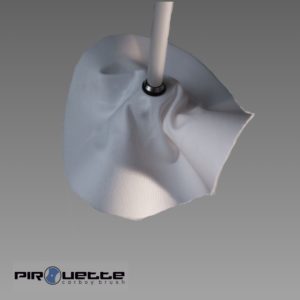
This is exactly the gap a rotary carboy cleaning brush fills. Instead of a rigid brush you push and twist by hand, a rotary cleaner — like the PIROUETTE — attaches to a standard cordless drill. The cleaning disc, made from a soft blend of cotton and sheep’s wool rather than abrasive bristles, spins at speed and uses centrifugal force to reach every inch of the interior, including the wide shoulders that a hand brush can never touch. It clears tartrate buildup and dried residue in a couple of minutes, without the scratching risk that comes from forcing a stiff brush against curved glass
.
Step-by-Step: A Cleaning Routine That Actually Works
- Rinse immediately after use. The single biggest time-saver is rinsing your carboy with warm water right after racking or bottling, before residue has a chance to dry and bond to the glass.
- Soak with a cleaner. Fill with warm water and a cleaning agent (PBW, OxiClean-free, or a washing soda solution) and let sit for at least an hour, ideally overnight for older residue.
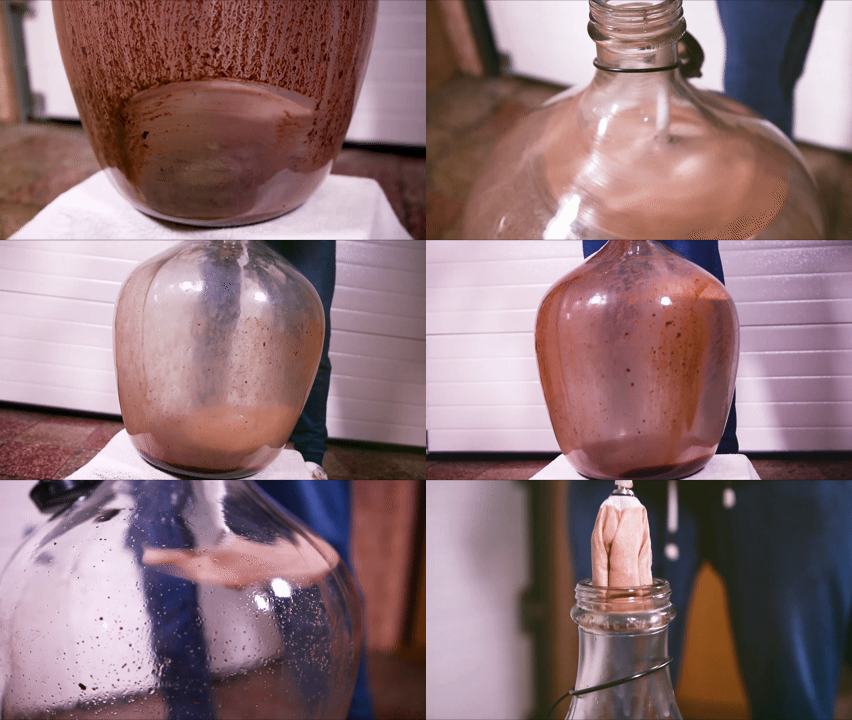
- Mechanically clean the interior. Attach a rotary cleaning brush to a drill, run it on a low-to-medium speed, and let it work through the loosened residue — top, shoulders, and bottom.
- Rinse thoroughly. Multiple rinses with clean water to remove all traces of cleaning agent.
- Sanitize before next use. Cleaning removes visible residue; sanitizing (with a no-rinse sanitizer like Star San) kills anything left behind that could affect your next batch.

Choosing the Right Size Brush
Carboys and demijohns commonly come in a few standard capacities — roughly 10–40 litres for the “small” range and 40–54 litres for the larger format. Using a cleaning disc sized for your vessel matters: too small and it won’t reach the full diameter of the shoulders; too large and it won’t fit through the neck comfortably. Matching the brush to your carboy size ensures full coverage in a single pass.
The Bottom Line
Cleaning a carboy doesn’t have to mean scratched glass, sore wrists, or a container you’re never quite sure is really clean. A short chemical soak followed by a proper mechanical clean — one that reaches every surface without abrasive bristles — takes the whole job from a dreaded chore to a five-minute routine between batches.
If you’re ready to stop fighting your carboy and start cleaning it properly, take a look at the PIROUETTE carboy and demijohn cleaning brush — built specifically to solve this problem, without the scratches.